Developer’s $200 Joke Game Earns $1.38M Before 99.9% Refund Wave
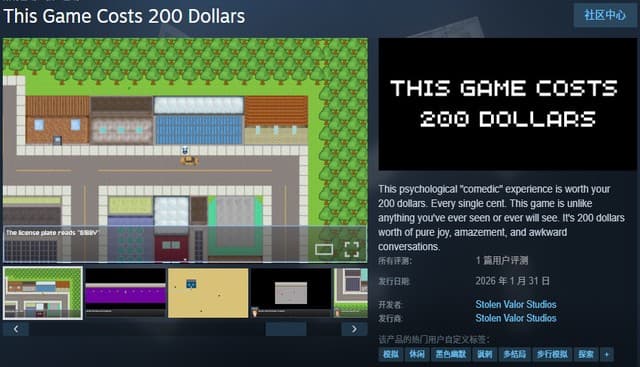

In January, an 18-year-old developer from New Hampshire named Michael Major launched a peculiar title on the PC platform: This Game Costs $200. Priced at exactly $200 (~¥1,349) — one of the highest price points a digital store allows developers to set — the game was an obvious prank from the start. Its store listing openly stated that the project was a complete scam, and the developer’s only goal was to test whether curiosity alone would drive players to buy it. What followed was a chain of events that surprised even the developer himself.
By any measure, the game itself barely qualifies as interactive entertainment. Players control a character wandering through a fictional city called Schizopia, a setting littered with beer and cigarettes, where they can chat with NPCs whose dialogue amounts to nothing more than empty rhetoric. Designed purely as a prank rather than a money-making venture, the title featured crude visuals and no meaningful gameplay beyond its walk-and-talk loop. The developer never expected anyone to purchase it, believing the steep price tag would scare off even the most curious buyers.

Months later, when Major finally checked his sales data, he was stunned: 6,717 copies had been sold, totaling approximately $1.38 million (~¥9.31 million). The celebration was short-lived, however. Of those purchases, 6,707 players requested refunds within the store’s two-hour playtime refund window, and 6,705 of them were Chinese players — most of whom never even opened the game. Among those who did play, the average session lasted roughly 10 minutes. In the end, only 10 buyers kept the game, pushing the refund rate to nearly 99.9%.

After the wave of refunds, platform revenue shares, and transaction fees, the $1.38 million figure dwindled to just $2,045 in the developer’s hands. Major speculated that many buyers may have purchased the game simply to collect store points, and he half-jokingly suggested that the batch-buy-then-refund pattern could even resemble money laundering. As unusual as the outcome is, a joke game with zero marketing still managed to turn a profit. It seems the prankster and the pranked found a strange equilibrium: one dared to sell, and thousands dared to buy — and then promptly ask for their money back.