AMD Confirms FSR 4.1 Is Coming to Xbox Series X|S Consoles
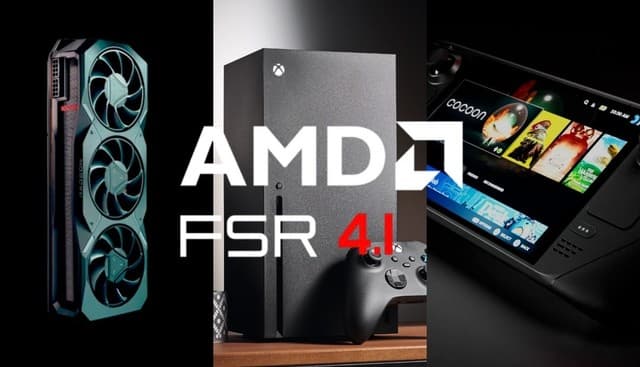

AMD has officially announced that its latest machine-learning super resolution technology, FSR 4.1, is expanding to the Xbox Series X and Xbox Series S consoles. It marks the first time the FSR 4 line has entered the console space since the technology debuted. According to AMD, the move gives Microsoft’s Xbox hardware a direct AI upscaling answer to the QSSR solution that recently arrived on Sony’s PlayStation 5 side. Neither company attached a launch window beyond a general “coming soon” timeframe.
FSR 4.1 had previously been limited to Radeon RX 7000 and RX 9000 series graphics cards, whose neural network model relies on higher-precision FP8 matrix acceleration hardware and carries a much heavier compute cost than the previous FSR 3 generation. Xbox Series X|S consoles share the RDNA 2 architecture with the Radeon RX 6000 series and lack the dedicated AI acceleration units found on RDNA 4 cards, so the hardware was originally left off the support roadmap entirely.

Overcoming that limitation came down to AMD reworking the model itself. AMD Senior Vice President of Gaming and Graphics Jack Huynh stated that the team adjusted the FSR 4.1 neural network to run at INT8 precision on the GPU’s shader cores rather than depending on FP8 matrix hardware. That change allows RDNA 2-based devices without dedicated AI accelerators to run the model, opening the door for the Xbox Series X|S console family to receive the feature.

The comparison to QSSR stems from the fact that both technologies draw on the same underlying work. “Project Amethyst,” a collaboration between Sony and AMD, produced the PSSR solution for PS5 Pro and its lighter QSSR variant, and also provided the technical foundation for the FSR 4.1 model optimization. Xbox chief technology officer Scott Van Vliet confirmed that Microsoft and AMD “have been working closely together” to optimize the technology for Xbox hardware. No specific release date has been announced. For Xbox players who have watched AI upscaling advance on other platforms, this is a welcome step, even if the timeline remains vague.