Racing Sim Guide Covers Lap Time Tips and MOZA Hardware Features

A comprehensive guide on improving lap times in racing simulators has been published, offering structured advice for newcomers looking to break through performance plateaus. The guide emphasizes that simply driving aggressively or endlessly lapping the track is counterproductive, often damaging confidence rather than building speed. Instead, it outlines a three-phase approach: familiarization with the circuit, establishing consistent braking points and racing lines, and finally pushing for faster lap times. The advice covers essential techniques from basic track awareness to advanced vehicle control methods, with a particular focus on how proper hardware setup can complement driver skill development.
According to the guide, beginners should first focus on learning circuit layouts without pushing the car to its limits. Drivers are advised to study track geometry, identify reference markers such as brake boards, and understand how corners connect before committing to an ideal racing line. Maintaining forward vision is critical for early corner detection and braking preparation. Once consistent valid laps are achieved, finding proper braking points using distance markers along the track becomes the next priority. The guide stresses that smooth steering with minimal correction produces the fastest lines, and that throttle application should begin only after the car’s nose is pointed toward the exit.

For drivers ready to improve lap times, the guide recommends trail braking as a key technique, applying the brakes linearly and progressively throughout the corner entry phase for more stable and faster exits. Vehicle setup is also addressed, with MOZA’s Pit House simulation control center cited as offering professional presets developed by champion drivers and sim racing influencers. The software supports titles including iRacing, LMU, AC, ACC, ACR, AMS2, and EAWRC, allowing one-click parameter matching. The MOZA R21 Ultra and R25 Ultra True Torque direct drive wheel bases feature the upgraded NexGen Force U1 force feedback algorithm, developed with input from dozens of professional drivers to optimize both rally and circuit racing feedback fidelity.

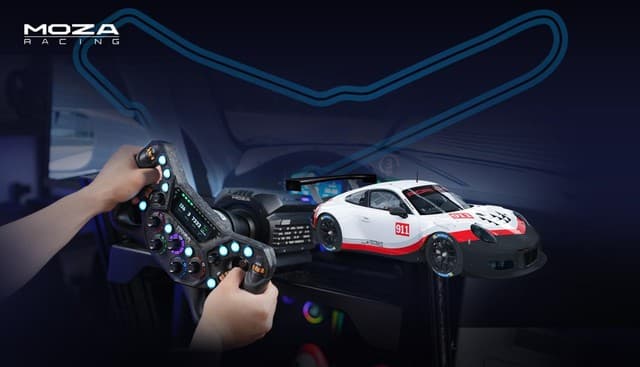
Smooth steering inputs are highlighted as essential for stability and tire preservation. The MOZA KS Pro steering wheel, designed with a 300mm GT racing standard size and butterfly-style grip, offers precise micro-adjustments and effortless large-angle rotation. Its 2.99-inch high-resolution display provides real-time wheel speed, tire pressure, slip rate, and lap time data, while 12 RGB shift lights and 6 flag indicator LEDs communicate track conditions. The guide also covers advanced curb usage, explaining how drivers can maximize track width by using standard curbs at circuits like Paul Ricard, and manage sausage curbs at Imola’s T2-T4 and T14-T15 complex corners. MOZA’s force feedback system, paired with the mBooster active pedal featuring dual 200kg pressure sensors, is designed to transmit detailed curb contact dynamics for precise braking control. This comprehensive approach provides a structured path for sim racers aiming to improve their performance behind the wheel.