Indonesia’s Game Rating System Faces Criticism Over Inconsistent Age Ratings
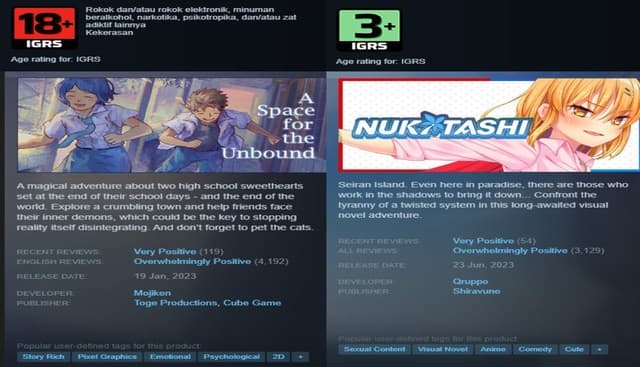

Indonesia’s game rating system has come under fire from both players and developers for what many are calling inconsistent and illogical age classifications. The controversy began when Indonesian game studio Toge Productions founder Kris Antoni publicly criticized the system, pointing out glaring inconsistencies in how games are rated. According to Antoni, an adult visual novel titled “NUKITASHI” received a 3+ rating, while his own studio’s game “A Space for the Unbound” was slapped with an 18+ rating simply because it contained a scene showing a student smoking. This has sparked widespread discussion among the gaming community about the reliability of Indonesia’s rating system.
The rating discrepancies extend to Chinese-developed games as well. The popular action game “Zenless Zone Zero” (绝区零) received a 16+ rating in China but only a 13+ rating in Indonesia. Meanwhile, the global phenomenon “Genshin Impact” (原神) typically carries a 12+ or 9+ rating in China but was given an 18+ rating in Indonesia. These significant differences have raised questions about the criteria used by Indonesian rating authorities and whether cultural differences are being properly accounted for in the evaluation process.

The inconsistent ratings are having real consequences for game releases in the Indonesian market. Several games have reportedly been blocked from release entirely due to their ratings. Notable examples include “Light and Shadow: Expedition 33” (光与影:33号远征队) and “Metal Gear Solid 3: Snake Eater” (合金装备3:食蛇者), both of which were deemed “unsuitable for release in Indonesia” by the rating board. This has frustrated developers who see their games being prevented from reaching Indonesian audiences based on what they consider arbitrary decisions.
Many industry observers believe the problem stems from how Indonesian rating agencies evaluate games. According to reports, the agencies often make decisions based solely on game covers and labels rather than actually playing or thoroughly reviewing the content. This superficial approach has led to the bizarre situation where adult-oriented content receives child-friendly ratings while relatively mild content gets restricted classifications. The gaming community continues to call for a more transparent and consistent rating system that properly evaluates actual game content rather than making snap judgments based on surface appearances. While rating systems are meant to protect younger audiences, the current Indonesian approach appears to be missing the mark in several notable cases.