Brazilian Battlefield 6 Player Sues EA Over False Ban and Wins
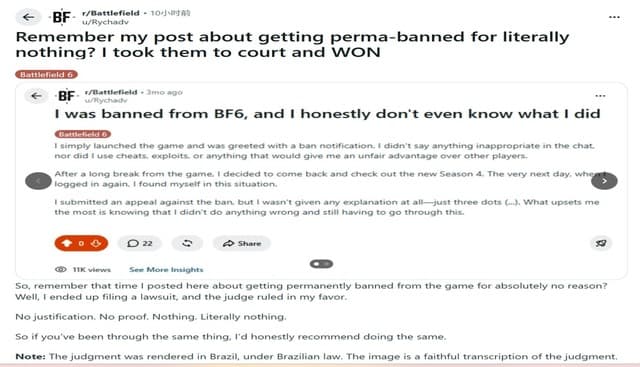

A Battlefield 6 player in Brazil has won a court case against EA after his account was banned without explanation, according to a report. The player, identified as Rychadv, sued the publisher after his appeals produced no reasoning or evidence for the ban. Roughly three months later, a judge ruled in his favor. The case highlights the friction between automated moderation systems and players who maintain they have done nothing wrong, and it is one of the few instances where a banned player has successfully challenged a publisher in court.
Rychadv stated that he never used cheat programs or exploits, and never posted inappropriate content. Despite this, he received a ban notification immediately upon launching Battlefield 6. When he submitted an appeal, the only response he received was a reply containing just “……”, with no justification or supporting evidence provided. The report notes that the player’s account carried the name “TheRealRych” at the time of the suspension.

Three months after the case began, the judge issued a ruling in favor of the plaintiff, confirming the validity of the emergency injunction relief previously granted. The court ordered EA to permanently restore full access to the Battlefield 6 account, including all licenses, progress and content the player had obtained. The ruling also declared the ban penalties issued on July 28 and August 30, 2026 void. No compensation was mentioned in the available information.
It is important to note that the verdict was issued under Brazilian law, and judicial rules differ between countries, so the outcome cannot be assumed to apply elsewhere. The ruling also stated that EA may still impose sanctions under its contract rules if future violations are properly proven. Separately, Battlefield 6’s “Casino Heist” update is set to launch on November 10 with a new map and new mode, while a quadruple XP event is currently running for weapon, career and battle pass progression. The legal win is a notable one for consumer rights, though its reach likely stays confined to Brazil.